See it in action
This is where the record gets made.
There's also a 90 second walkthrough of Stratum Track.
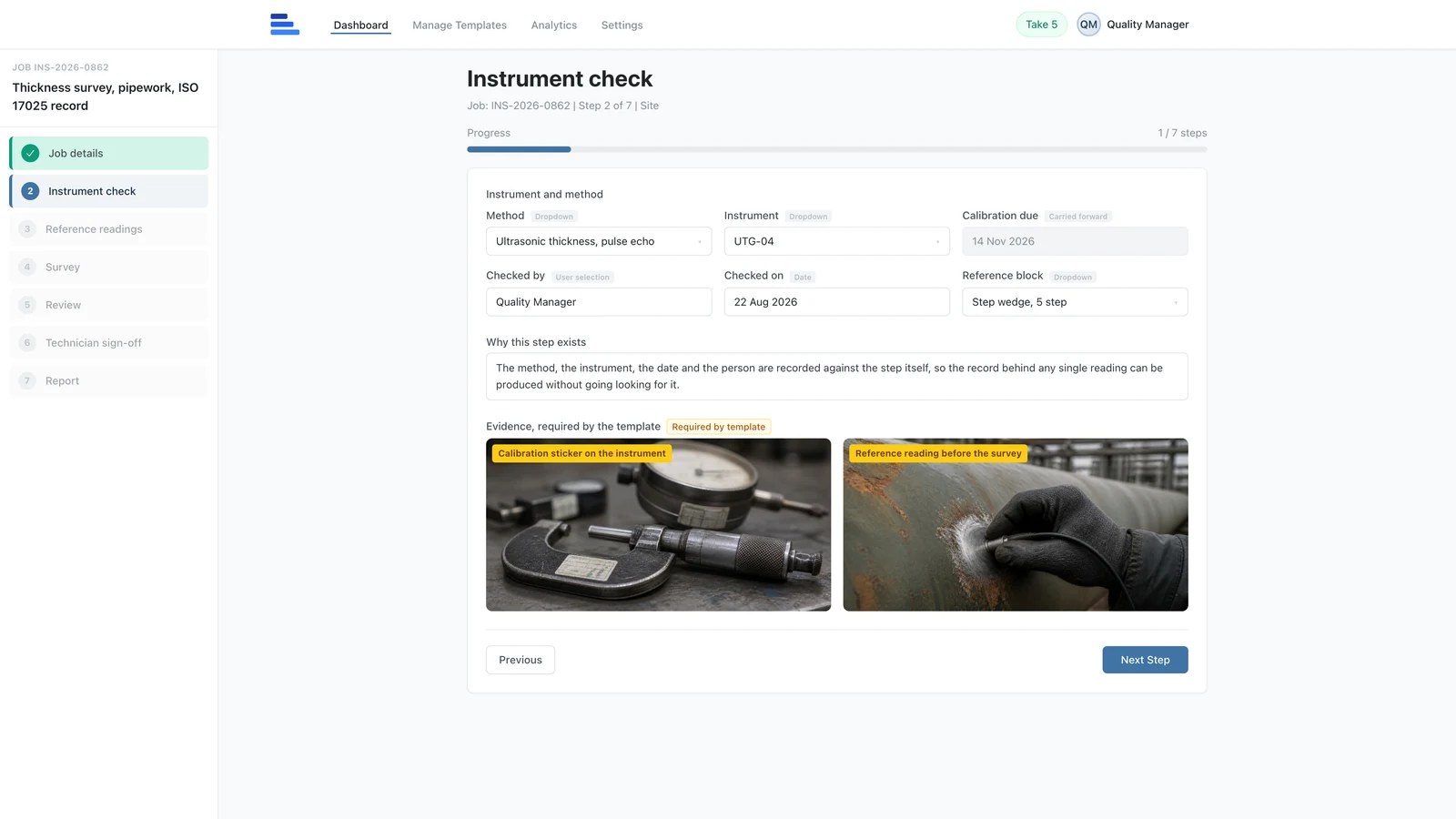
Stratum Track records the method, the date and who checked it against the step itself. That's the ISO 17025 record.
The work is already being done properly. What changes is when the record of it gets made: while the job is running, by the people running it.
Your report, your accreditation, your controlled document. Nothing to send us, and no sales call.
The record behind a result sits across a job card, a photo folder and a spreadsheet.
Stratum Track records the method, the date, the person who ran the test and the person who checked it against the step they belong to, with the photographs on the same step.
The write-up happens after the job rather than during it.
Your technician records it on the step they are standing in front of, so the record is made while the work is being done.
The fortnight before an assessment turns into a document hunt.
The evidence is already on the job, so the answer to “how do you know?” is the record itself. NATA assesses your laboratory. We aren't part of that assessment.
Every client and every standard wants the same facts in a different layout.
One job template holds many client-facing report templates, so the same captured data produces each document without anyone rebuilding it.
If one of those is yours, this is what Stratum Track does about it.
See it in action →
There's also a 90 second walkthrough of Stratum Track.
You may have scheduling, capture and compliance sorted already, with the report at the end the last thing still done by hand. Stratum Track does that part. You keep what you run now, and we build it from the report you already issue.
The template is yours. Your people sign it off. We rebuild the report your quality system already approves, in the format you already control.
Stratum Track holds no accreditation of its own and certifies nothing. NATA assesses your laboratory, not our software, and no software makes anybody compliant.
The work is already being done properly. What changes is when the record of it gets made: while the job is running, by the people running it.
Stratum Track captures the method, the date, the person who ran the test and the person who checked it, each against the step it belongs to rather than typed up later.
An assessor picks a result and asks for the record behind it. It's on the job, with the date, the person and the photographs attached to the step they came from. NATA assesses your laboratory. We aren't part of that assessment.
Inspection records with the inspector named and every finding recorded against the item it was found on.
Chasing nuclear or submarine supply work means proving what was done, step by step. Stratum Track records each step as it happens, on the workshop floor you already have.
Inspection points sit in the job. Where your template asks for a photograph, the step won't close until someone takes it.
The objective evidence an auditor asks for, produced by your people getting on with the job in the weeks before, not by a scramble the week of.
Stratum Track runs your ITP as the job itself. A hold point that hasn't been signed blocks the next step instead of being noticed later. More on inspection test plans.
One job template holds many client-facing report templates, so the MDR documents your people produce generate from the same job data. We don't hold or verify third party material or mill certificates, so the outside paperwork is still yours to gather.
Send us one report you issue today. We build it into a working job inside Stratum Track, with the branded document it produces, and send it back within 24 hours. It costs you nothing.
Show me on my own report →Pick the part that costs you the most time and we'll show you exactly how Stratum Track handles it, using the report you issue today. No sales call, and you don't have to send us anything.
Stratum Track is built and run from Perth, Western Australia. The person who reads your document is the person who builds your workflow.